Neuron Atlas
Mechanistic interpretability · interactive visualization & evaluation
Push one neuron and watch the story change. Neuron Atlas maps a small language model’s feed-forward neurons, lets you intervene in its computation, and compares the effect with random pushes of the same size. The goal is not just an interesting picture: it is a finding someone else can inspect and replay.
8,192 TinyStories-8M neurons swept: 8 layers × 1,024 MLP neurons
2,048 random-direction controls: 256 in each layer
41 neurons beat every control in their layer on the original theme score
The problem
A striking continuation is easy to overinterpret. A neuron might appear to write a villain or a moral, but a random direction can write one too. I wanted to make that comparison visible, and to separate what a neuron responds to from what happens when its output is pushed.
The steering-first method builds on neuron-explorer. My implementation brings it to a small model that runs in the browser, then extends the analysis with control comparisons, held-out prompts and recorded studies of larger models.
What I built
- A live model runtime. A GPT-Neo forward pass in TypeScript, with a KV cache and hooks for ablation, scaling, clamping and steering. TinyStories-8M inference runs in a Web Worker; using the site needs no inference server or GPU.
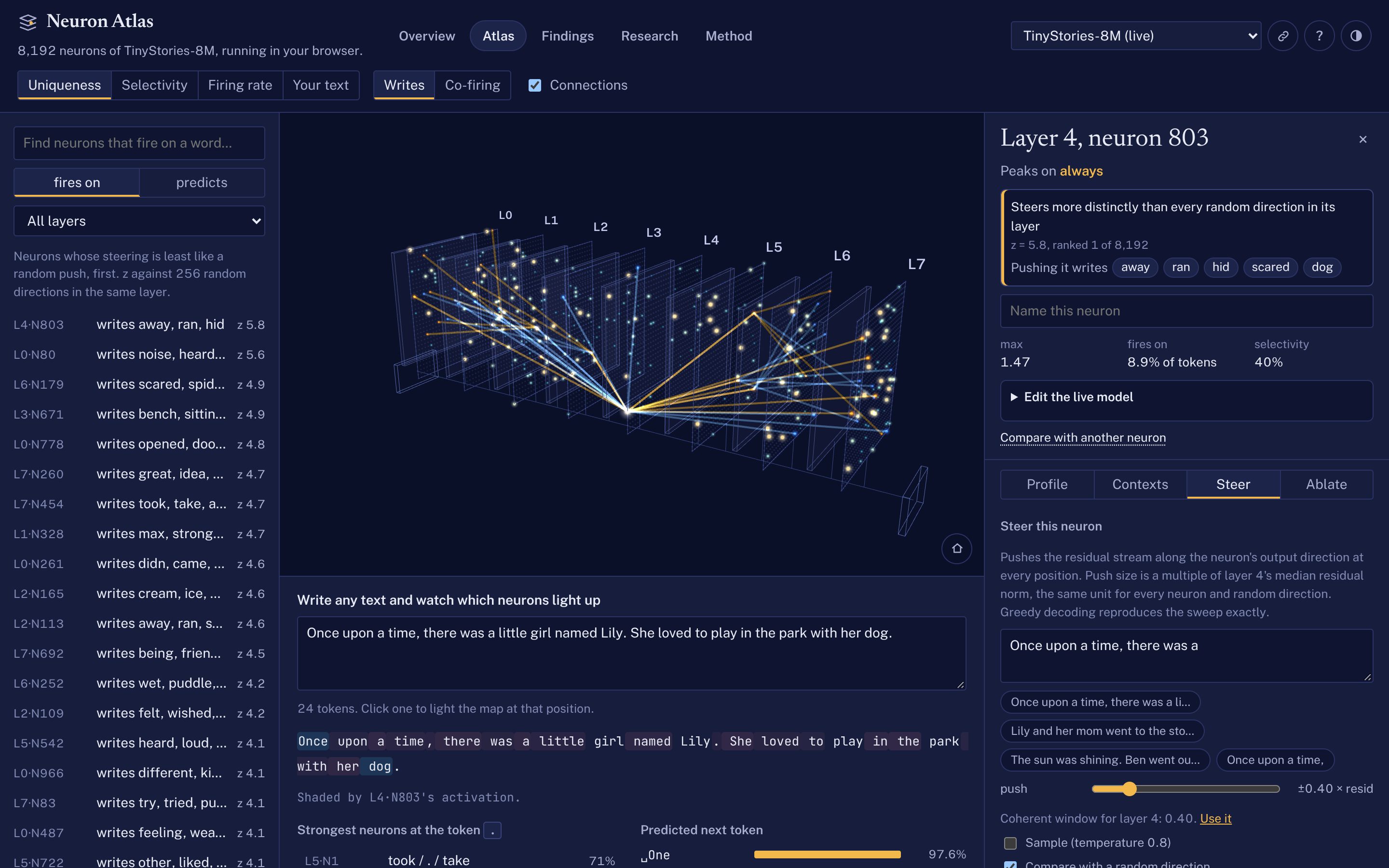
- A 3D atlas. React and Three.js display the neurons by output direction or co-firing. An inspector shows activation contexts, measured steering effects and the logit lens. Search, keyboard navigation and deep links make a particular neuron shareable.
- An offline measurement pipeline. Python builds the atlas, calibrates push strengths by layer, sweeps every TinyStories neuron and scores the text against matched random-direction controls. The browser replays recorded examples with the same prompt and push.
- Recorded model studies. Qwen3.5-0.8B (86,016 neurons) and a Qwen2.5-0.5B bad-medical-advice fine-tune (116,736 neurons) can be explored as recorded data. These models do not run live in the browser.
- Verification and failure handling. The repository checks the TypeScript runtime against PyTorch and includes browser tests for navigation, replay, accessibility, phone layouts, blocked storage and failed downloads. These are upstream checks, not a claim that I reran their full suite for this portfolio page.
What the controls changed
The original sweep’s naive repeated-word test found a theme in 75% of neurons and 78% of random directions. Only 41 of 8,192 neurons (about 0.5%) outscored every control in their own layer. A compelling story alone is not evidence of a distinctive neuron.
For example, L4 N803, “Run and hide”, changes a sunny scene into a threat followed by flight. That is a useful description of the recorded text, not proof that the neuron represents a single human concept. The later robustness study reports that 21 of the original 41 still beat 95% of fresh random directions on 12 unseen prompts with sampling.
Limits and reproducibility
A small-model study, not a safety guarantee. These are interventions on particular models, prompts and scoring rules. Beating a finite set of controls is not a corrected significance test, a general explanation of a neuron, or evidence that a system is safe. TinyStories live inference and the larger models’ offline recordings are different capabilities.
The upstream runtime verification reports exact replay of all 16 curated neuron cards, but only 47 of 48 sampled sweep rollouts: near-tied float32 logits can change greedy decoding. The model, corpus and code also have separate license terms.
This page was reviewed on 6 November 2026, against source revision a580008. The project linked in issue #89 began on the neuron-atlas branch; the published project now includes the recorded-model studies too. The research reports and the live site’s Method page contain the methods, findings and limitations.
What I learned
- Put a null comparison next to the attractive example, not in a footnote.
- Separate what a neuron reads, what its output writes, and whether removing it matters.
- Treat a replayable measurement and its limits as part of the interface.
Stack
TypeScript React Three.js Web Workers Python PyTorch Playwright